
Code guide
P0300 — random or multiple cylinder misfire
A misfire the computer couldn't pin to a single cylinder. That usually points at something the whole engine shares — but there's a per-cylinder count underneath the code that often names a favourite anyway.
Misfire · Generic OBD2 · P0301–P0312 identify a specific cylinder
Read this first
If your check engine light is FLASHING, stop driving as soon as you safely can. A flashing light during a misfire means unburned fuel is going into the exhaust, where it can destroy a catalytic converter within minutes. Reduce load, avoid hard acceleration and high speed, and get off the road. A steady light with a misfire code is far less urgent — but a flashing one is the difference between a spark plug and a converter.
The short version
A misfire means a cylinder didn't produce the power it should have. The computer detects it by watching the crankshaft: every firing event should give the crank a small kick, and when one doesn't arrive on schedule, that's a misfire.
P0300 specifically means the misfires were spread around rather than concentrated in one cylinder. That points away from a single failed coil or injector and toward something all the cylinders share — fuel, spark timing, air, or compression across the board.
Three things to do before replacing anything:
- Read the freeze frame. The conditions when the misfire set narrow the field enormously. Detail below.
- Check the per-cylinder misfire counts. "Random" often still has a clear favourite. Detail below.
- Look for other codes. A lean code, a MAF code, or an EGR code alongside P0300 is usually the actual cause, and the misfire is the symptom.
Reading codes, freeze frames, live data, and the Mode 06 monitor results are all free in Fixiom — always, no credits and no subscription.
Freeze frame is the tiebreaker
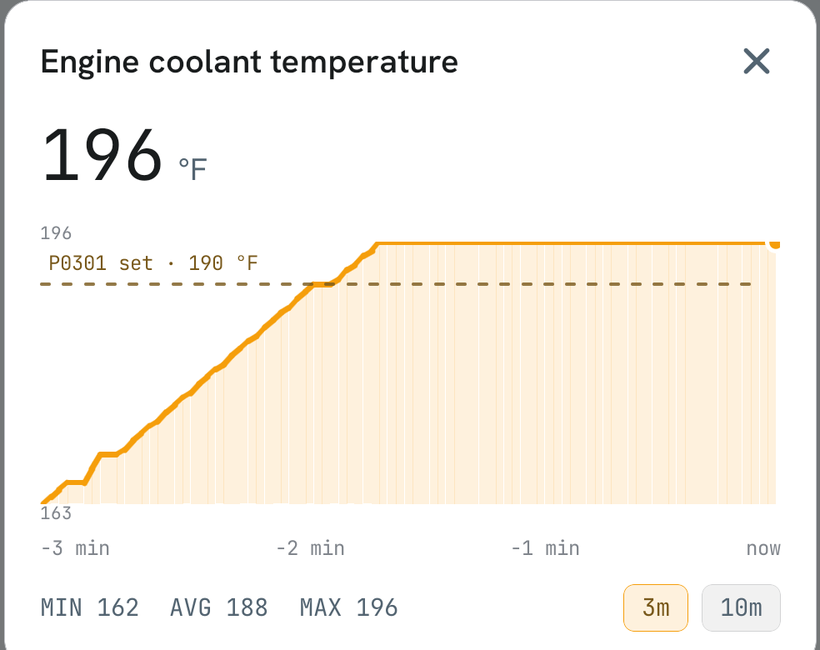
When a code sets, the computer photographs the conditions: engine speed, load, coolant temperature, fuel trims, vehicle speed. That snapshot is stored with the code, and on a misfire it's the most valuable single thing you have — because when an engine misfires narrows why dramatically.
- Misfires only when cold, clears up warm → think fuel delivery when cold, weak spark that improves as things expand, or a coolant temperature sensor telling the computer the wrong story.
- Only under load or during acceleration → the ignition system is being asked for its hardest work. Worn plugs with too much gap, tired coils, or fuel that can't keep up under demand.
- Only at idle, smooths out when driving → vacuum leaks and EGR problems live here. Both matter most when airflow is lowest.
- Everywhere, all the time → something mechanical or badly out of adjustment. Compression, timing, or a fuel-pressure problem across the range.
Fixiom shows the freeze frame alongside the code on the codes screen, in US units, and marks it clearly as the conditions when the fault set rather than what's happening now.
The per-cylinder counters
This is the part most people never see, and it's often the fastest route to an answer.
Your engine computer doesn't just count misfires — it counts them per cylinder, and those counts are available over the OBD2 port in what's called Mode 06. Fixiom shows them on the emissions screen, grouped by cylinder, typically with both a recent-average count and a current-cycle count.
The reason this matters: P0300 sets when misfires are spread across cylinders — but "spread" doesn't mean "even." It's very common to find one cylinder carrying most of the count and the others picking up a few. That cylinder is where to look first, even though the code refused to name it.
And when the counts genuinely are even across all cylinders, that's real information too — it's strong evidence for a shared cause rather than a component on one cylinder.
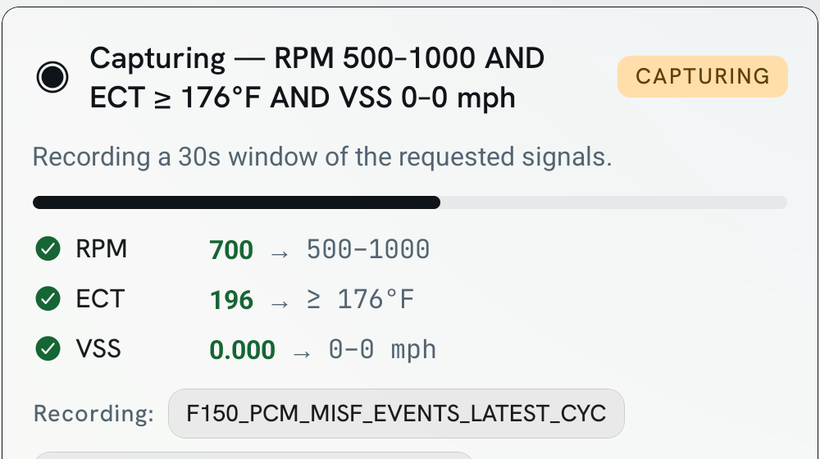
Honest caveat: misfire counters under Mode 06 are well standardised, but some carmakers implement additional tests in their own private formats. Fixiom shows those but labels them as manufacturer-specific instead of guessing what a private test measures.
What causes a random misfire
Roughly in order of how often they turn out to be it:
- Ignition components at the end of their life. Spark plugs are consumable and the gap grows as they wear; a set that's overdue can misfire under load across every cylinder at once. Coils and, on older engines, plug wires age the same way.
- A vacuum leak. Unmetered air leans out the mixture enough to cause misfires — and this one usually brings a lean code along with it. If you have P0300 and P0171 together, chase the lean condition first and the misfire often goes with it.
- Fuel delivery. A weak pump, a clogged filter, or dirty injectors starve every cylinder together. Fuel trims and, where the vehicle reports it, fuel rail pressure are the live-data signals.
- EGR stuck open. Too much exhaust gas recirculated at idle dilutes the mixture and causes exactly the idle-only misfire pattern.
- Low or uneven compression. The mechanical answer, and the one live data can only hint at. Suspect it when a specific cylinder is consistently the worst on the Mode 06 counts and ignition and fuel have been ruled out.
- Timing that's drifted. A stretched timing chain or a slipped belt changes valve events enough to misfire across the board, usually with rough running that's obvious by ear.
P0300 versus P0301 through P0308
The distinction is worth being precise about, because it changes the entire approach.
- P0300 — misfires detected, not attributable to one cylinder. Start with shared causes.
- P0301, P0302, P0303 and so on — the last digit is the cylinder number. P0301 is cylinder 1. That's a component conversation about that specific cylinder, and it has its own diagnostic path built around swapping parts between cylinders and seeing whether the fault follows.
It's completely normal to see P0300 alongside one or more specific-cylinder codes. Read that as: there's a general problem, and one cylinder is suffering worst.
Cylinder numbering is not the same as physical front-to-back position and varies by engine layout — worth confirming for your specific engine before pulling anything apart.
What a phone adapter can't see
What it genuinely gives you: the misfire codes, the freeze frame conditions, per-cylinder misfire counts under Mode 06, fuel trims, oxygen sensor activity, and live engine data you can chart while the engine misfires. That's a substantial amount of the picture.
What it cannot do:
- A compression test or a leakdown test. These are the definitive mechanical tests, and both need a gauge threaded into the spark plug hole.
- Look at a spark plug. The condition of a plug that's been running in a misfiring cylinder is genuinely informative, and it requires taking it out.
- Test a coil properly. Live data can point at a cylinder; confirming a coil means swapping or bench-testing it.
- Hear it. A misfire has a sound and a feel, and neither travels down an OBD2 cable.
Common questions
What does P0300 mean?+
The engine computer detected misfires it could not attribute to a single cylinder. It watches the crankshaft for the small acceleration each firing event should produce, and flags the ones that don't arrive. Spread-out misfires usually point to a cause the cylinders share.
Can I drive with a P0300?+
If the check engine light is flashing, no — stop as soon as you safely can. A flashing light during a misfire means raw fuel is entering the exhaust and can destroy the catalytic converter within minutes. With a steady light it's less urgent, but a misfire is still worth diagnosing promptly.
How do I find which cylinder is misfiring if the code says random?+
Check the per-cylinder misfire counts under Mode 06, which most apps don't surface. P0300 means the misfires were spread out, but they're often not spread evenly — one cylinder frequently carries most of the count, and that's where to look first.
What's the most common cause of a random misfire?+
Worn ignition components — spark plugs at the end of their service life are the single most common answer, followed by coils. After that, vacuum leaks, fuel delivery problems, and EGR faults. If a lean code appears alongside P0300, chase the lean condition first.
What's the difference between P0300 and P0301?+
P0300 means the misfires couldn't be pinned to one cylinder, so you look for shared causes. P0301 names cylinder 1 specifically — the last digit is the cylinder number — which points at a component on that cylinder. Seeing both together means a general problem with one cylinder suffering worst.
Does a misfire always mean spark plugs?+
No, though worn plugs are the most common single cause. Vacuum leaks, fuel delivery, EGR faults, low compression, and timing problems all cause misfires. The freeze frame conditions and the per-cylinder counts are what tell them apart before you spend money.
Related guides
- P0301 — Cylinder 1 misfire — and the swap test that proves the cause in one drive.
- P0171 — System too lean — where fuel trims tell you the answer in about two minutes.
- Check engine light flashing — A flashing light is not the same warning as a steady one. What to do right now.
The computer said random. The counters usually disagree.
Codes, freeze frames, live data, and Mode 06 monitor results are free in Fixiom — always. Start with the evidence the code left behind.